
The Divine Scripture That Locked Itself at Inception
How Guru Arjan Dev Ji 'Digitally' Designed the Adi Granth to Be Arithmetically Proof Against Interpolation, Extrapolation, and Deletion

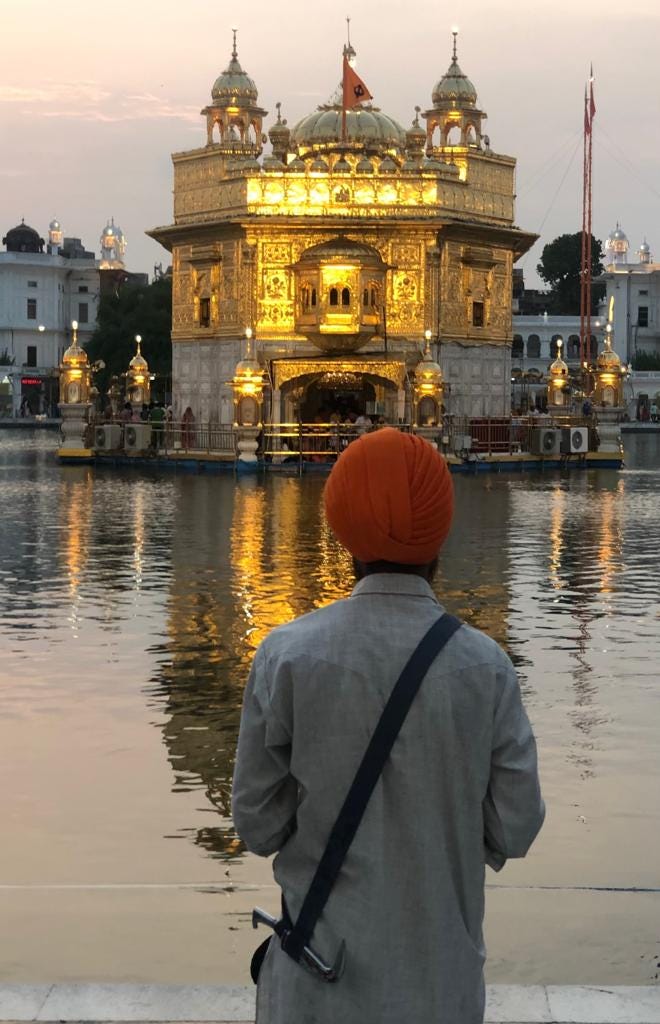
Composed in Devotion, Designed in Digits
In the year 1604, at Ramsar on the banks of the sacred sarovar in Amritsar, a remarkable act of intellectual architecture was completed. Guru Arjan Dev Ji, the fifth Sikh Guru, presided over the compilation of a scripture unlike any other in the world. The Adi Granth — later expanded and sealed by Guru Gobind Singh Ji in 1706 at Talwandi Sabo into what Sikhs revere as Sri Guru Granth Sahib — was not merely composed. It was “digitally” designed.
At a time when the printing press was unknown in the subcontinent, when manuscripts were routinely corrupted by copyists, when religious traditions were vulnerable to the slow accretion of interpolated verse and convenient theological addition, Guru Arjan Dev Ji embedded into the very structure of the text a verification system of extraordinary sophistication. It is a system that most Sikhs encounter every day in the Gurdwara — and almost none can fully explain. Yet its elegance and ingenuity demand attention well beyond the Sikh community. Any informed reader — scholar, theologian, historian, or simply a curious mind — who pauses to understand what Guru Arjan Dev Ji actually built in 1604 will recognise it for what it is: one of the most remarkable acts of intellectual architecture in the history of sacred literature.
I. The Problem Every Scripture Faces
The textual corruption of sacred literature is not a theory. It is history. The Mahabharata grew from 24,000 to over 100,000 verses across centuries. The Bible’s scholars have spent generations parsing which epistles are Pauline and which are interpolated. The Hadith tradition developed an entire science — Ilm al-Rijal, the study of transmitters — precisely because fabricated sayings of Prophet Mohammad (PBUH) proliferated. Even the Vedas, transmitted orally with extraordinary care, carry layers of commentary and addition that scholars continue to disentangle.
Guru Arjan Dev Ji was acutely conscious of this danger. The Sikh movement was barely sixty years old. Its Gurus had already attracted imitators and rivals — including Guru Arjan’s own brother Prithi Chand — who composed verse in styles designed to mimic the Gurbani. The risk was not hypothetical. Unauthorised compositions existed. Left unchecked, they would have found their way into the sacred corpus.
The solution the Fifth Nanak devised was not institutional — no council of guardians, no hereditary custodians. It was arthematical.
II. The Architecture of the Lock
Open the Sri Guru Granth Sahib to any page. What appears to be liturgical notation is, in fact, a multi-layered coding system. Each composition carries at its head a precise set of identifiers:
The Raag — one of 31 classical Indian musical frameworks — establishes the container. All compositions in Raag Aasaa are grouped together; all compositions in Raag Bhairo together. The Raag is not merely a performance instruction. It is a classification boundary. Any verse inserted into the wrong Raag would immediately violate the musical logic that every trained singer would recognise.
Within the Raag, the Ghar notation specifies the rhythmic cycle — the taal — to be employed. The form is then stated: whether the composition is a Chaupada (four stanzas), a Dupada (two stanzas), a Tipada (three stanzas), an Ashtpadi (eight stanzas), or another form. A forger attempting to insert a five-stanza composition into a sequence of Chaupadas would break an immediately visible structural rule.
The authorship marker follows. Compositions by the Gurus themselves are labelled Mahalla 1 through Mahalla 5 — house of the first, second, third, fourth, fifth Guru — reflecting the Sikh theological principle that successive Gurus shared one light, one spirit, one jot. Compositions by the fifteen Bhagats — among them Kabir, Namdev, Ravidas (Guru Ravidaas to millions), Farid, and Trilochan — carry their own names. This attribution is structural, not decorative. It creates a segregated authorship chain that cannot be quietly merged or blurred.
III. The Checksum: The Genius Hidden in Plain Sight
All of the above is visible and reasonably well-known among scholars. What is almost universally overlooked is the system embedded at the end of each composition — and, crucially, at the transition points between groups of compositions.
Three consecutive pages of the Guru Granth Sahib — angs 481, 482, and 483, all from Raag Aasaa, all containing the verses of Bhagat Kabir Ji — illustrate the system with unusual clarity. They are reproduced here as photographed from an actual Bir (Saroop).
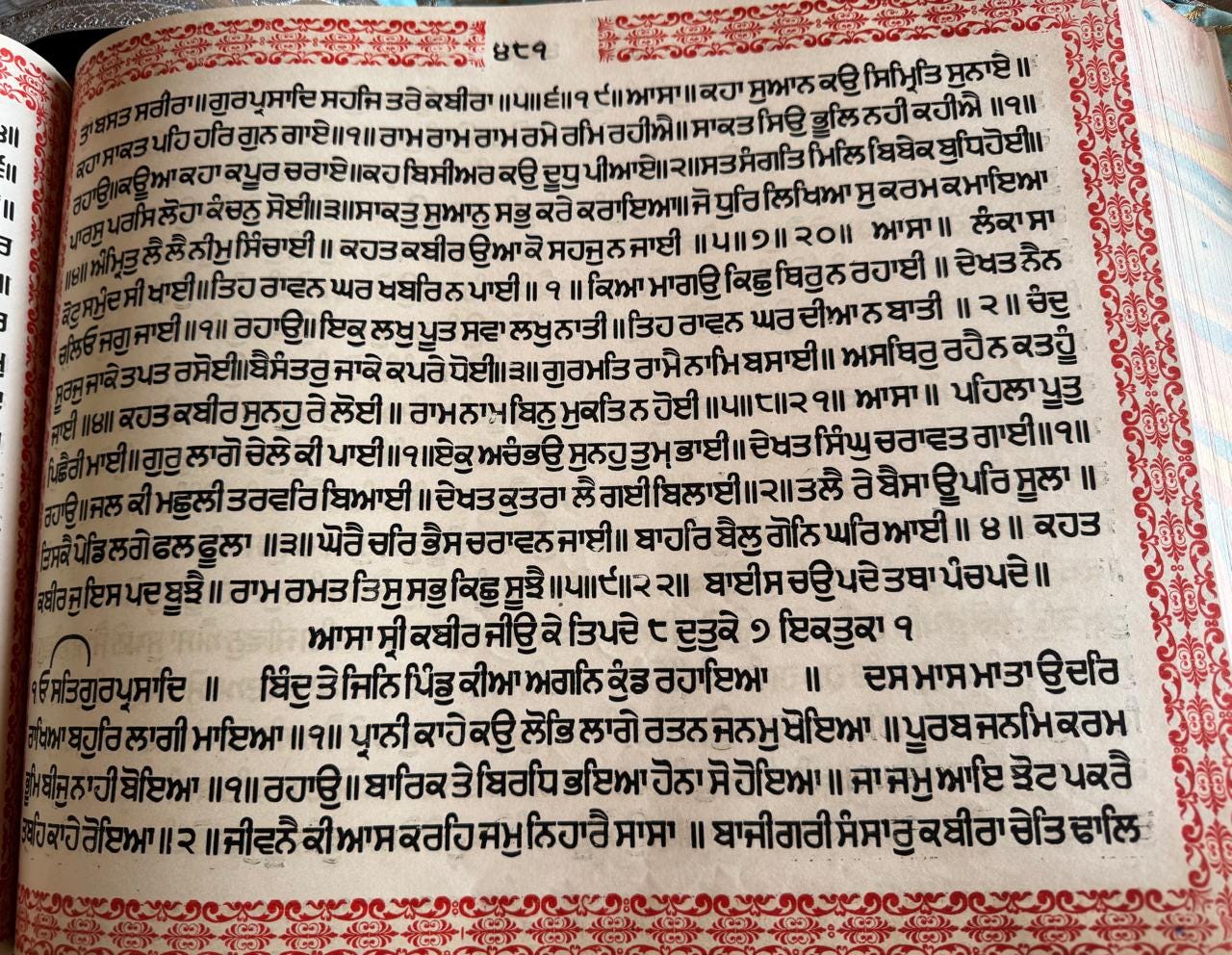
The section-summary line on Ang 481 is the first thing to notice. Midway down the page, after the concluding shabad of the Chaupada group, appears a standalone declaratory line in larger script:
Aasaa Sri Kabir Ji-o ke Tipade 8, Dutke 1, Ikatuka 1
This is a prospective inventory — an announcement, before the Tipadas begin, of precisely how many compositions of each form are to follow in this sub-section: eight three-stanza compositions (Tipadas), one two-stanza composition (Dutka), one single-stanza composition (Ikatuka). A reader — or an auditor — can verify the count before reading a single line. It is a table of contents embedded inside the text, with the numbers declared in advance serving as a commitment the compiler cannot subsequently alter without detection.
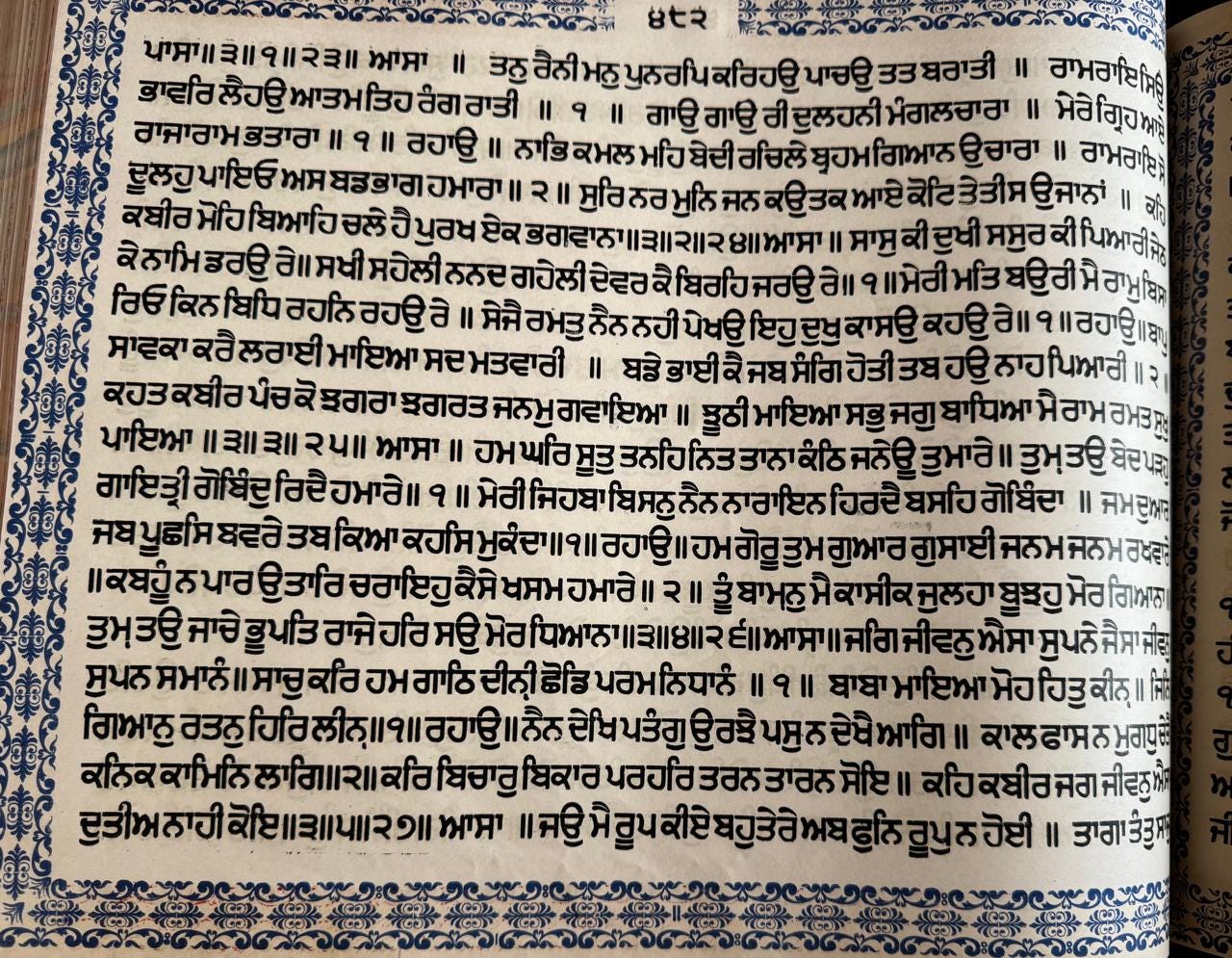
The triple-counter at the close of each shabad is the second mechanism. As each composition ends on angs 481, 482, and 483, three numbers appear in sequence. They are not decorative. Each carries independent meaning, and together they constitute what a modern computer scientist would recognise as a cascading checksum.
The first number records the stanzas in that specific composition. The section-summary on ang 481 announces Tipadas — three-stanza compositions — and the counters honour that commitment precisely. The first Tipada begins at the bottom of ang 481 and closes at the very top of ang 482 with ∥ 3 ∥ 1 ∥ 23 ∥ — three stanzas confirmed. Further into ang 482, another Tipada closes with ∥ 3 ∥ 3 ∥ 25 ∥ — again three stanzas. On ang 483, the final Tipada in the group closes with ∥ 3 ∥ 8 ∥ 30 ∥ — three stanzas once more, confirming it is indeed a Tipada exactly as the section-summary promised. Every counter in this sequence opens with 3. A copyist who dropped a stanza, or added one, would immediately produce a mismatch.
The second number is a running tally of Bhagat Kabir’s Tipadas within this sub-section. The counter at the top of ang 482 reads 1 — the first Tipada. By mid-ang 482 it reads 3 — the third. On ang 483 it reaches 8, exactly matching the Tipade 8 declared in the section-summary on ang 481. The two numbers, separated by two full pages of dense verse, are locked in correspondence. Insert a spurious Kabir shabad anywhere between them and the final tally reads 9, not 8. The advance declaration and the terminal count no longer agree.
The third number is the grandest counter of all: the cumulative total of all compositions in the broader section of the Raag, across every contributor — the Gurus and all the Bhagats whose verses appear together. The counter at the top of ang 482 reads 23, meaning Kabir’s Tipadas follow twenty-two earlier compositions in Raag Aasaa. By ang 483 the master count reaches 30. Immediately after, a new sub-section opens — Aasaa Sri Kabir Ji-o ke Dupade — and the very first Dupada closes with ∥ 2 ∥ 1 ∥ 31 ∥: two stanzas, the first Dupada, the thirty-first composition overall. The master counter has advanced by exactly one. It continues to advance, without interruption, through every subsequent shabad regardless of author.
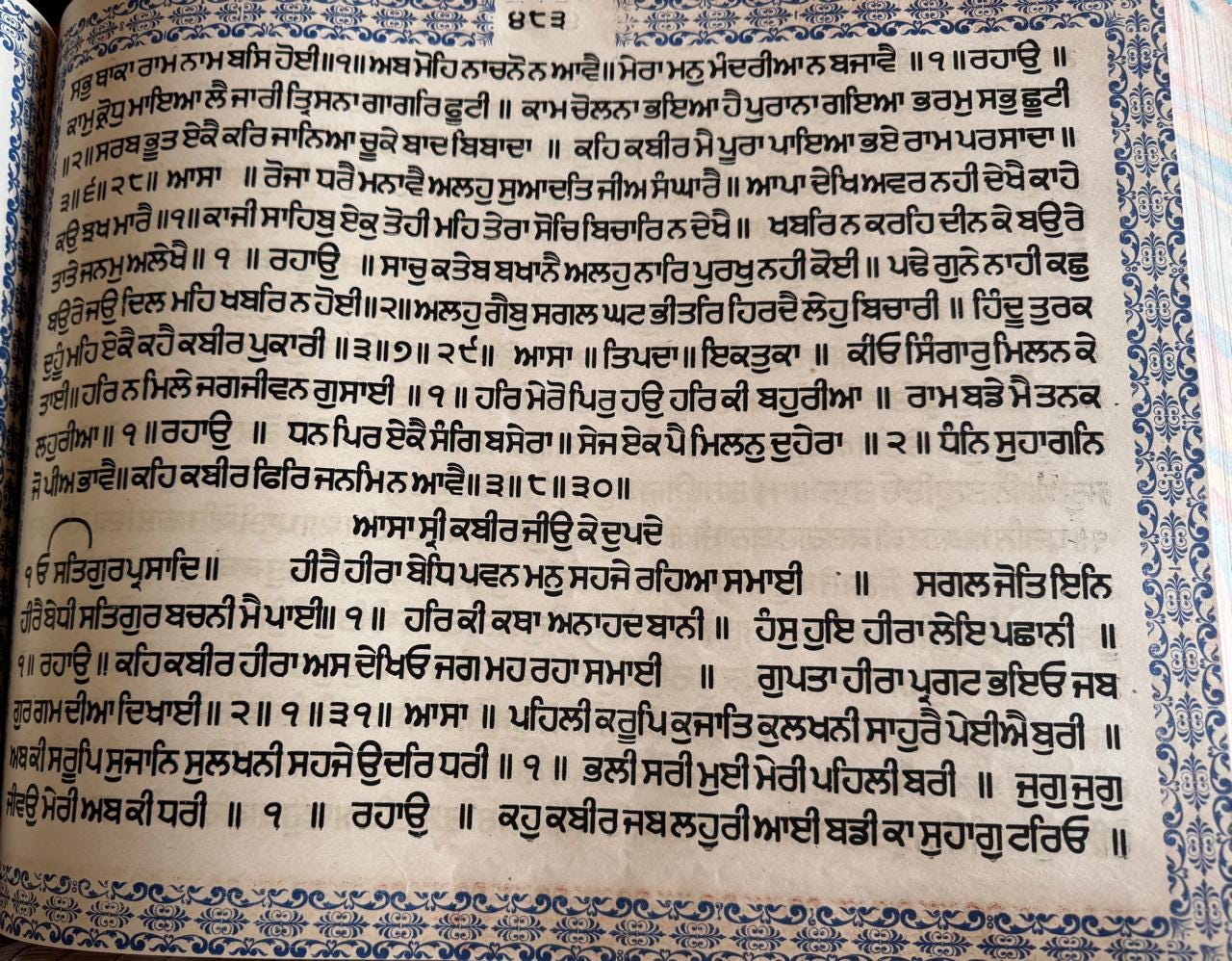
The elegance is devastating in its simplicity. An interpolator seeking to insert a verse would have to simultaneously falsify the stanza count, the contributor tally, and the master cumulative counter — and do so consistently across every subsequent shabad in the Raag. A deletor faces the identical problem in reverse. The prospective section-summary must also be rewritten to match. The numbers are not a footnote. They are a lock with multiple simultaneous tumblers, and the key was thrown away in 1604.
IV. What Kabir’s Verses Tell Us About the System’s Purpose
The Bhagat compositions are especially significant in this context. Bhagat Kabir Ji — the fifteenth-century weaver-poet of Varanasi whose verses cut across caste, religion, and orthodoxy with fierce, luminous directness — is the most extensively represented of all the non-Sikh voices in Sri Guru Granth Sahib. His inclusion was itself a theological statement: that divine revelation was not the property of any single tradition or community.
The verses visible across these three photographed pages illustrate both the range of Kabir’s voice and the precision of the system that preserves it. On ang 481, the Tipada sub-section opens with: Bind te jini pind kia, agni kund rehaaia, das maas mata udar rakhia — “From a single drop He fashioned the body, sustained it in the fire of the womb for ten months.” The Rahao line — the pivot verse that carries the shabad’s central teaching — follows: Praani kahe ko lobh laage, ratan janam khoiaa — “O mortal, why are you ensnared by greed? You are squandering a jewelled birth.”
On ang 482, Kabir addresses spiritual self-deception with characteristic economy: Jagi jeevanu aisa supno jaisa, jeev supan samaan — “This waking life is no more than a dream; the living being is dream-like.” On ang 483, after the eight Tipadas conclude and the Dupada sub-section opens, the first Dupada begins: Hiri hira bedhi pavan manu sahje rehia samai — “The diamond has pierced the diamond; the mind, stilled in breath, has merged in equipoise.” It closes, precisely, with ∥ 2 ∥ 1 ∥ 31 ∥ — two stanzas, first Dupada, thirty-first composition in the sequence.
These are not pious generalities. They are precise, individual, irreplaceable formulations. The coding system ensures that these words — exactly as Bhagat Kabir spoke them — are the words a reader encounters today on ang 481, ang 482, and ang 483 of every Bir in the world. Not an approximation. Not a pious corruption. The original.
V. The 1430-Ang Final Seal
In 1706, at Damdama Sahib in Talwandi Sabo, Guru Gobind Singh Ji recited the entire Guru Granth Sahib from memory to Bhai Mani Singh, incorporating the compositions of Guru Tegh Bahadur Ji, the priceless verse of Salok Mahalla 9. This became the definitive recension — 1430 angs (literally, limbs — not pages, for the scripture is regarded as a living body), fixed in sequence, fixed in pagination.
Every Bir (Saroop) — every copy of the Guru Granth Sahib — in every Gurdwara in the world contains exactly 1430 angs. Ang 481 is the same everywhere. The shabad at a given position on a given ang is the same in Amritsar, London, Toronto, and Singapore. This final standardisation completed the architecture: not only were the internal counters locked, but the physical location of every word in the universe of copies was made uniform.
VI. What This Means
Religious scriptures are among the most consequential documents in human civilisation. They shape law, ethics, identity, and the deepest questions of meaning. Their integrity — or lack of it — matters.
Sri Guru Arjan Dev Ji, working without computers, without printing presses, without institutional enforcement mechanisms, constructed a textual verification system that has held for over four hundred years. Sri Guru Granth Sahib is, to the best of scholarly knowledge, free from interpolation. Not because custodians were vigilant — though they were — but because the text itself makes corruption structurally visible.
It is a remarkable achievement by any measure. For the 30 million Sikhs worldwide who regard Sri Guru Granth Sahib as the embodiment of the living Guru — not a historical record but a present, speaking reality — it is something more. It is the assurance that the voice they hear in the Gurdwara is the voice that was heard orignally in Amritsar.
The numbers at the end of every shabad are not liturgy. They are a guarantee.
KBS Sidhu is a retired IAS officer (Punjab 1984) and Founder-Editor of The KBS Chronicle. He recently published an English translation of Sukhmani Sahib: The Guru’s Pathway to Inner Peace.
This is amazing!