
Over-Regulation as Strangulation in Higher Education: Chasing Quality, Centralising Control, and Whittling Down State Autonomy
One Regulator to Lord It Over Them All? The Viksit Bharat Shiksha Adhishthan Bill, 2025—Federalism and the Ideological Storm in Higher Education

Author Credentials: KBS Sidhu, retired IAS and former Special Chief Secretary, Punjab, has, over a 37-year civil service career, served as Administrative Secretary for School Education, Higher Education, Technical Education, and Medical Education in Punjab. He was one of the architects of Punjab’s first-ever private university policy (2008–09). In this article, he offers a critical, experience-based analysis of the proposed national legislation to govern and regulate higher education in India.
One Regulator to Rule Them All? The Viksit Bharat Shiksha Adhishthan Bill, 2025
The Viksit Bharat Shiksha Adhishthan Bill, 2025 (VBSA) arrives with the promise of a clean, modern architecture for Indian higher education: one umbrella commission with three specialised councils—regulation, standards and accreditation—replacing the familiar alphabet-soup of the UGC, AICTE and NCTE for non-medical and non-law education. The pitch is seductive. Fewer overlaps. Faster approvals. Uniform quality norms. Greater transparency. A single public portal where institutions disclose their faculty strength, courses, finances and accreditation status. In a system notorious for delay, duplication and discretion, the idea of one clear rulebook has obvious political appeal.
But VBSA is not just a governance reform. It is a constitutional moment. It recasts Centre–State relations in education, alters the balance between regulation and autonomy in the private sector, and—most explosively—intensifies a long-running ideological conflict over who gets to shape the national mind. If it passes in something close to its reported form, India may gain clarity at the price of contention: a cleaner structure, but a sharper fight.
How VBSA differs from what NEP 2020 imagined
The National Education Policy 2020 had already proposed a single apex arrangement in the form of the Higher Education Commission of India (HECI), with distinct verticals separating regulation, accreditation, standards-setting and funding (my live video recorded five years ago). That “separation of functions” was meant to end the old conflict where one body both set the rules and controlled the purse strings. VBSA appears to retain the spirit of that design—light regulation, tight accountability—but it also seems to rearrange it in a more executive-centred direction.
The biggest difference is where financial power sits. Instead of housing a funding vertical within the regulator’s internal design, the Bill, as described, shifts grants and funding decisions more squarely into the Union Education Ministry’s hands. This may reduce conflicts of interest inside the regulator; it also concentrates leverage in the ministry, which can attach conditions to grants and schemes. In a country where many universities—especially state universities—survive on a mix of state support and central schemes, separating funding from regulation does not necessarily weaken the Centre’s influence. It can strengthen it, because the Centre may control both the compliance gate (through standards and approvals) and the incentive lever (through money), even if the levers are housed in different offices.
And then there is what the Bill does not touch. VBSA explicitly does not apply to medical education and legal education—two domains where credentials are high-stakes, admissions are fiercely contested, and professional regulators are historically powerful. Whether one calls it “pragmatism” or “political economy”, the optics are unavoidable: the state is prepared to radically restructure non-medical, non-law higher education, while leaving the most sensitive sectors outside the new umbrella. That carve-out will weaken the claim that VBSA is a comprehensive reset, and strengthen the suspicion that reform is being attempted where resistance is manageable.
Pitroda’s old diagnosis: are we curing under-governance, or centralising it?
Two decades ago, the UPA-1 era National Knowledge Commission chaired by Sam Pitroda offered a diagnosis that still feels contemporary: Indian higher education is “over-regulated and under-governed”. VBSA clearly attacks the “over-regulated” side by consolidating regulators and reducing overlap. Yet the deeper problem in Indian higher education has rarely been the number of regulators alone. It has been the quality of governance: opaque admissions practices, weak institutional management, variable faculty standards, politicised appointments, poor academic outcomes, and a culture where compliance paperwork substitutes for learning.
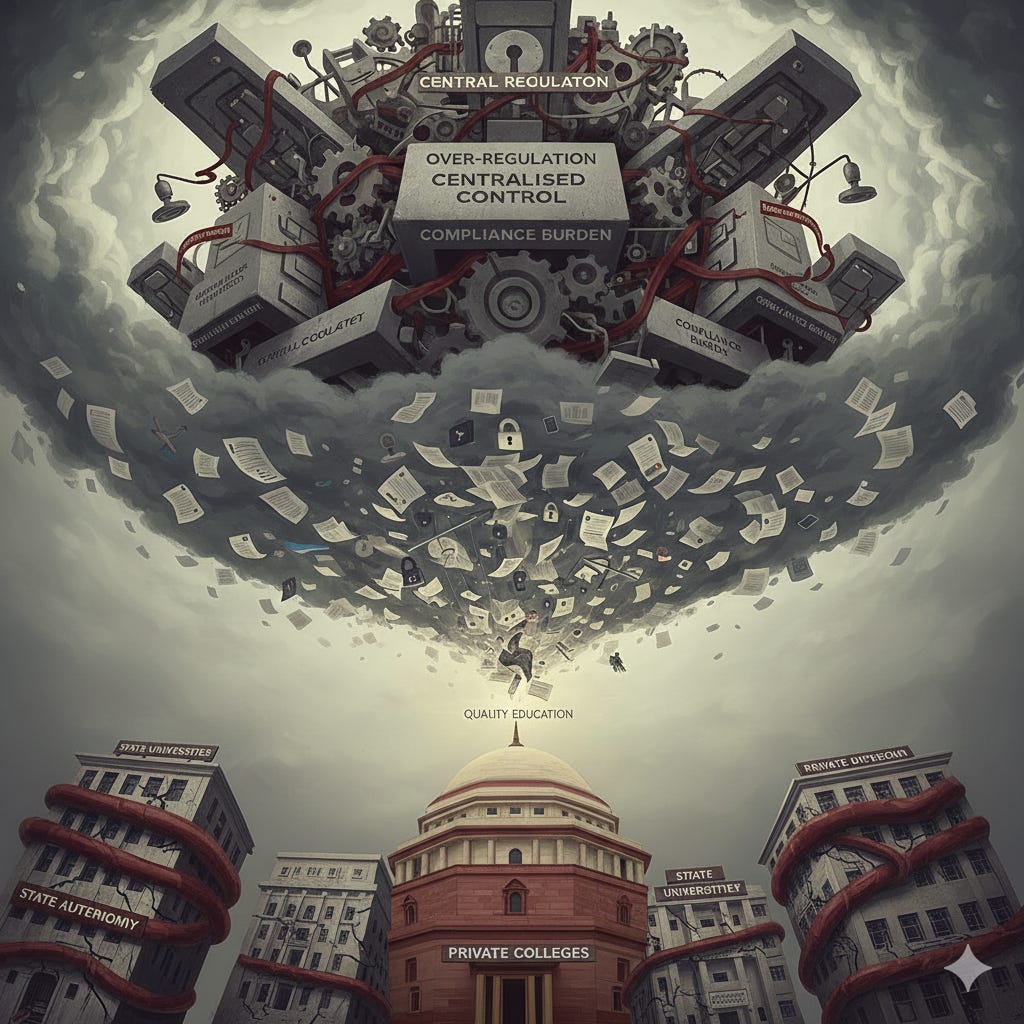
A single regulator can, in theory, improve governance by clarifying norms and reducing rent-seeking at multiple doors. But a single regulator can also become a single chokepoint. Under-governance can be replaced by over-centralised governance, where institutions become more anxious about permissions than about pedagogy. If the system’s habit is to treat universities as administrative units rather than intellectual communities, VBSA may streamline the pipes without changing the water.
That is why the Bill must be judged not by its organisational chart but by its safeguards: transparent criteria for approvals; proportionate penalties; predictable timelines; and credible, independent appeals. If those are weak, “light but tight” can become “tight and discretionary”.
The ideological storm: why “saffronisation” and RSS allegations will dominate the debate
The fiercest controversy around VBSA may not be procedural at all. It may be ideological. For years, Indian higher education has been a battlefield of competing narratives—about history, culture, nationhood, and the purpose of education itself. Charges of “saffronisation”, and allegations (fairly or unfairly) that education policy is being shaped by an RSS-influenced worldview, have recurred with textbook debates, curriculum choices, and institutional appointments.
VBSA intensifies those anxieties because centralisation magnifies the stakes of control. A decentralised or plural regulatory ecosystem contains friction and diversity by design; a centralised framework raises the fear that one ideological centre can set the tone for the entire system. Even if the Bill is framed in neutral language of “standards” and “quality”, the politics of implementation will be read through the prism of who appoints whom, who issues directions, and who decides what is “policy”.
This is not a mere rhetorical problem. When a statute concentrates authority, it reduces the number of insulating layers between the executive and the university. That makes every regulatory dispute vulnerable to being interpreted as ideological pressure—especially in a climate already thick with suspicion. In such an environment, the government’s best defence is not insistence that concerns are “political”; it is institutional design that makes political capture harder: transparent appointments, independent accreditation processes, published reasons for decisions, and meaningful appeals.
What VBSA could improve—if it behaves like a modern regulator
It is possible to argue for VBSA without becoming blind to its risks. Consolidation can reduce duplication and contradictory norms. A credible accreditation regime can discourage the lowest-quality institutions and raise the floor. Mandatory disclosures—faculty strength, finances, courses, outcomes—can reduce information asymmetry for students and parents. Separating funding from regulation can reduce the old temptation to use grants as informal control within the regulator. And a “single-window” regime can reduce the compliance burden that often cripples honest institutions while doing little to eliminate bad ones.
But each of these benefits is conditional. Disclosures must be verified, not merely filed. Accreditation must be rigorous, not ritualistic. Penalties must be proportionate and procedurally fair, not punitive theatre. Most importantly, the regulator must resist becoming an instrument of day-to-day executive preference.
The federal heart of the controversy: what happens to state powers to create universities?
This is where VBSA’s impact will be felt most sharply. Constitutionally, states have competence in education and can establish universities through state legislation. Nothing about a central higher-education statute usually prevents a state legislature from passing a law to create a new public university or a private university. The crucial change is not about whether a state can legislate a university into existence; it is about whether that university can operate meaningfully without passing through a centrally controlled gateway.
Under a centrally driven approvals-and-standards regime, the state may retain the formal power to create, but lose practical autonomy over operation. A state-created university—public or private—may find that it cannot function as a fully recognised degree-granting institution unless it complies with national norms on approvals, accreditation and standards. Put differently, the “power to establish” may remain, but the “power to operationalise” is increasingly gated.
In practical terms, VBSA could centralise control over: recognition and legitimacy of programmes; permission to start new courses or departments; expansion to new campuses; approval for online, distance or blended modes; accreditation-driven eligibility; and compliance-related restrictions or penalties. A state may pass the university Act, appoint a vice-chancellor, allocate land, and fund buildings—yet still face a national regulator that determines how and whether the institution’s programmes are recognised and how it is allowed to grow.
This has two consequences. First, it narrows the ability of states to craft differentiated regional policies for higher education. If the norms are uniform and approvals centralised, a state’s capacity to respond to local labour markets, language priorities, or regional development needs may be squeezed into a national template. Second, it shifts the Centre–state relationship from collaboration to dependence. In a scheme-driven system, the ministry that controls funding and the regulator that controls approvals can jointly shape the trajectory of institutions that are, nominally, state universities.
Will “central approval” be required for a state to legislate a university? Likely not in a formal sense. But central approval may become the de facto requirement for the university’s programmes, degrees and growth to carry national validity. That is exactly the kind of shift that triggers constitutional friction: not abolition of state power, but hollowing it out through operational gating.
Private universities and T.M.A. Pai: does a single regulator strengthen standards or weaken autonomy?
The private sector question cannot be separated from the Supreme Court’s seminal jurisprudence beginning with T.M.A. Pai. The Court recognised that private, including minority, institutions have a right to establish and administer educational institutions, while also permitting reasonable regulation to ensure standards, prevent maladministration, and protect students from exploitation. Later decisions refined the equilibrium around admissions and fees—autonomy yes, profiteering no; managerial discretion yes, capitation and arbitrariness no.
VBSA’s effect on this constitutional balance will depend less on what the Bill avoids saying, and more on how it uses what it does say. If the new regime limits itself to genuine quality norms, transparent accreditation, and disclosures, it could improve standards while keeping the Pai equilibrium intact. It might even reduce the old “multiple clearances” culture that private institutions often describe as harassment-by-fragmentation.
But if the new system turns approvals and penalties into tools of micromanagement—especially if criteria are vague, enforcement uneven, and appeals weak—the Bill could end up eroding the very autonomy that the Court sought to protect. A “single window” can become a “single veto”. For private universities, particularly newer ones created under state laws, the practical fear will be that the Centre can determine the institution’s future by controlling permissions for programmes and expansion.
Minority institutions: important, but not the Bill’s main battlefield
Minority institutions deserve protection and clarity, but they need not dominate the VBSA debate. Much of the most combustible litigation around minority rights, admissions and high-demand professional education often arises in medicine and law—both outside VBSA’s direct scope. Still, the principle remains relevant: standards must be maintained, but minority rights to administer should not be eroded indirectly through opaque regulatory pressure.
For that reason, minority institutions should get a smaller but serious place in the argument: VBSA must include explicit procedural safeguards, and its implementation culture must respect constitutional rights while enforcing genuine academic standards.
The real question: can India get clarity without losing trust?
VBSA is best understood as a trade-off offered to the public: fewer regulators and greater uniformity in exchange for greater central direction. For supporters, that is the only way to end regulatory chaos and improve quality. For critics, it is a blueprint for recentralisation that will squeeze states, chill universities, and—through the concentration of appointment and direction-making powers—enable ideological steering.
The Pitroda diagnosis remains a useful compass: India needs less ritual regulation and more genuine governance. VBSA will be a success if it makes universities freer to teach and research while holding them accountable for quality. It will be a failure if it makes universities more fearful of permissions than focused on learning, and if it turns a diverse federal education system into a centrally managed instrument vulnerable to culture-war politics.
One cannot build world-class higher education on compliance alone. Nor can one build a plural republic’s intellectual life on distrust. VBSA, at its core, is not merely a Bill to restructure regulators. It is a test of whether India can modernise higher education without converting it into another theatre of central power—administrative, financial, and ideological—all at once.